
Table of Contents
- How to Measure for Jeans and Match Your Waist-to-Hip Ratio
- Best Women's Denim Brands and the Judy Blue Jeans Sizing Guide
- How to Find Flattering Jeans for Curvy Women: Silhouettes, Washes, and Tailoring
- Frequently Asked Questions
Last Updated: September 14, 2026
How to Measure for Jeans and Match Your Waist-to-Hip Ratio
Learning how to find flattering jeans for curvy women starts with two numbers, not a size tag.
Measure your natural waist at its narrowest point, then your hips at their fullest. A 10-inch difference or more signals you need curvy-fit engineering: a contoured waistband that curves inward instead of gapping at the back.
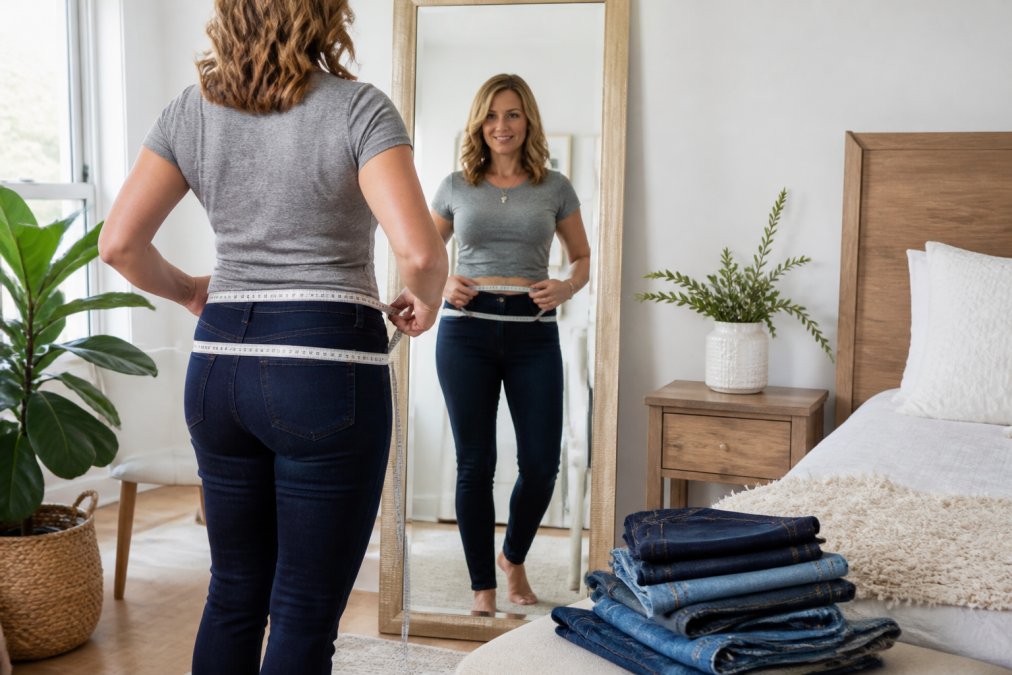
Measure your inseam from crotch to ankle bone, and note your rise preference: high rise sits at or above the navel, mid rise just below.

Most size charts grade hips and waist together, which is why a pair that fits your hips gaps at your waist. The ASTM International body measurement standards exist precisely because bodies don't scale uniformly.
Best Women's Denim Brands and the Judy Blue Jeans Sizing Guide
Judy Blue uses juniors sizing, so your number is typically one to two sizes smaller than your department-store size, a 14W often maps to a Judy Blue 11/30 or 13/31. The brand builds in comfort-stretch and tummy control panels.
Here's how the conversion typically runs:
Your Misses/Plus Size |
Judy Blue Size |
Typical Inseam |
|---|---|---|
10-12 |
9/29 or 11/30 |
29-30 in |
14-16 |
13/31 or 15/32 |
31-32 in |
14W-16W |
14W or 16W |
31-32 in |
18W-20W |
18W or 20W |
31-32 in |
For other labels, the FTC's guidance on textile and apparel labeling requires accurate fiber content and country of origin on every tag, so check the elastane percentage before you buy. Two to three percent elastane gives structure. Above five percent, expect the denim to relax through the day.
How to Find Flattering Jeans for Curvy Women: Silhouettes, Washes, and Tailoring
High rise beats mid rise for most curvy frames. A high rise at or above the navel holds the midsection and lengthens the leg line; mid rise works if you're short-waisted.
Straight and bootcut flatter more bodies than skinny. A straight leg skims the thigh without clinging, and wide-leg works when the rise is high enough to anchor it.

Washes matter more than you think. Dark washes with minimal distressing read polished and create a longer vertical line; keep distressing away from your widest point.
Tailoring is cheaper than you think. Taking in a waistband costs a fraction of a new pair, and any dry cleaner with a sewing machine can do it. Petite frames should look for a 27-29 inch inseam or plan on a hem.
Build a capsule instead of a pile. Three pairs cover almost everything: a dark straight-leg for work, a medium-wash bootcut for weekends, a relaxed wide-leg for comfort days. Wash inside out in cold water and hang to dry.
For sustainable options, look for brands using recycled cotton or lower-water finishing. The EPA's textile waste reduction guidance notes that keeping garments in use longer is one of the most effective ways to cut the environmental footprint of your closet.
At Shop With Karolyn, we carry sizes XS through 4X with daily new arrivals and fit videos in our VIP community.
Frequently Asked Questions
What rise is most flattering for curvy figures?
High-rise jeans, usually 10 to 12 inches, sit at or above the natural waist and reduce waist gapping while smoothing the midsection. Mid-rise works for shorter torsos but can dig in during movement. Try a contoured waistband style like the Judy Blue High Waist Tummy Control Peggy Ankle Straight Jean, which follows your hip-to-waist grading instead of cutting straight across.
How do I prevent waist gap in my jeans?
Measure your waist and hip separately, then shop for denim cut with hip-to-waist grading rather than a single straight measurement. A contoured waistband curves inward at the back, which closes the gap.
How should jeans fit around the thighs and hips?
The hip should sit smooth with no pulling across the pockets, and the thigh should have enough room to pinch about half an inch of fabric. Straight and bootcut silhouettes balance a curvy lower half because the leg line continues without clinging. Tapered legs can work if the rise and hip are correct, but wide-leg cuts need a defined waist so the silhouette stays balanced rather than boxy.